

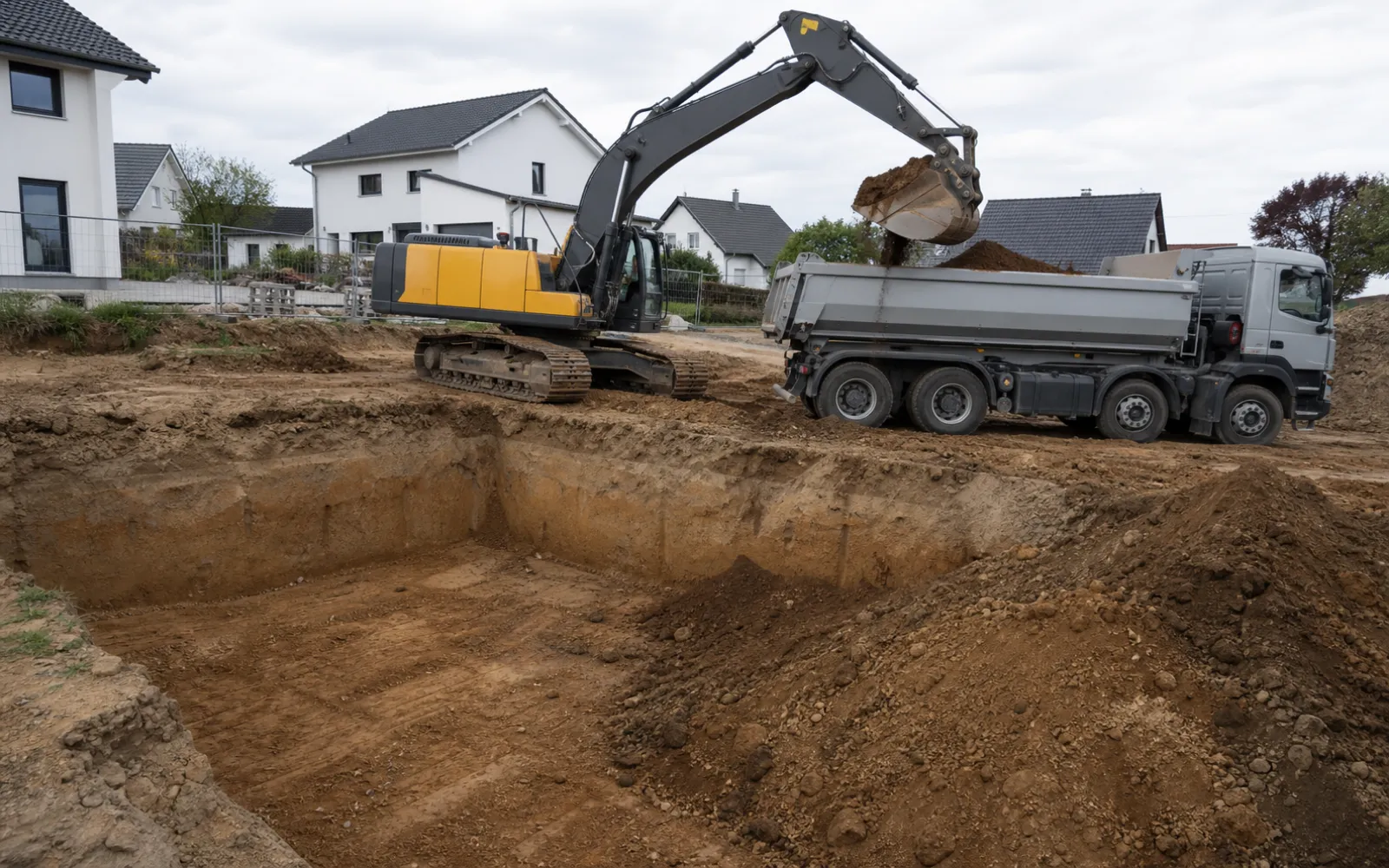
In this article
Two quotes for the same excavation can cover very different services: one may include only excavation and loading, while the other also includes removal, acceptance fees, temporary storage, backfill material and compaction. The lower total price is therefore not automatically the better-value quote.
Anyone requesting an earthworks contractor should check which quantities, ground zones, transport routes and ancillary services have been priced.
Basis of calculation: current plans, ground conditions and site logistics
The calculation requires a clearly identified revision of the plans. The documents on which the quote is based must show the excavation geometry, including depth, width, working spaces, battered slopes, trenches, ramps and soil-replacement zones. The quote must also state how later design changes will be reflected in the quantities.
Position, levels and sections define the geometry.
The usual requirements are an up-to-date site plan, relevant floor plans and sections, foundation or basement plans, and information about the terrain, road, access and future outdoor areas. The architectural design before the planning application also provides important foundations for this work.
Soil and water conditions must be assessed before pricing.
The geotechnical report must describe the soil profile, engineering properties, groundwater or perched water and any identifiable anomalies. Existing environmental investigations should also be included with the enquiry.
Access, working space and setup areas affect the method.
Photographs and dimensions of the access, plot boundaries, neighbouring buildings, services, overhead lines, possible storage areas and the intended loading point show which machines and vehicles can actually be used.
Excavation volume: geometry, bulking and the measurement unit
The volume of the building is not the same as the excavation volume. Depending on the design, additional quantities arise from working spaces, battered slopes, topsoil stripping, trenches, local deepenings, ramps and extra depth for soil replacement or blinding layers.
The measurement unit and method of determining the quantity must be defined for each item. Quantities may be measured in cubic meters of in-situ soil, loose bulk volume, metric tons according to scale records or documented truckloads. Only then can the final quantity be verified.
The geometric volume is calculated from the excavation geometry.
It is based on the design dimensions, levels and intended excavation geometry. Verifiable measurement requires the actual dimensions to be documented.
Excavation increases the proportion of voids in the soil.
On a truck or in a temporary stockpile, soil occupies more space than it did in its undisturbed state. The bulking factor used for this conversion must suit the material and be stated in the quote.
Volume and weight limit a truck in different ways.
Heavy or wet material reaches the permissible payload before the body is full; with lighter material, usable body volume limits the load. Bulk density, moisture content, payload and loading volume must be stated transparently as calculation assumptions.
Managing excavated soil
Excavated soil is not automatically landfill material. Depending on its engineering properties, environmental classification, construction sequence and the space available, it may be reused on the plot, stored temporarily, recovered elsewhere or disposed of.
Material streams must remain separate: topsoil, natural subsoil, made ground, construction debris, asphalt, concrete residue and suspect material. Mixing can rule out recovery routes and lead to higher disposal costs.
The required investigations and documentation depend on the intended handling route. For reuse on the plot, the placement area and site conditions are decisive. If the material is to be transferred off site, the required analysis and assessment must also meet the receiving facility's acceptance criteria.
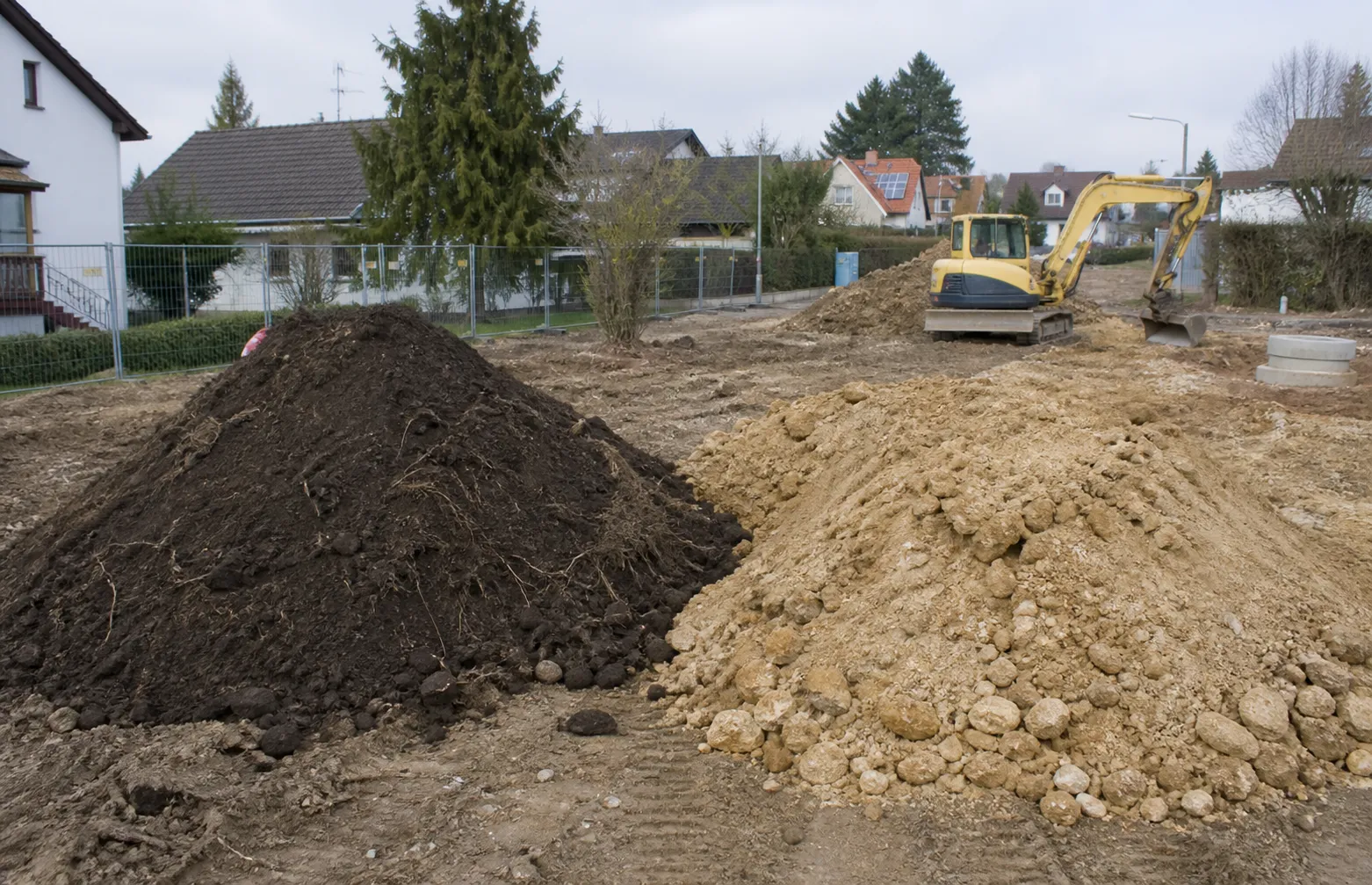
Separate and assess the material, then define its route.
Suitable soil can reduce removal and imported material.
It must be clear where the material will subsequently be placed, whether it is suitable in engineering and environmental terms, and how it will be stored separately in the meantime. Topsoil must be preserved separately for later use and protected against mixing and unnecessary compaction.
Storage is not a cost-free interim solution.
Temporary storage requires a suitable area and the material must be handled again. Creating stockpiles, keeping materials separate and using additional plant must all be included in the calculation.
The receiving facility and recovery route must suit the material.
Recovery may require testing and classification as well as evidence that the material meets the intended facility's acceptance criteria. A laboratory analysis alone does not guarantee acceptance.
Landfill costs include more than the gate fee.
They also include loading, transport distance, vehicle type, waiting time, weighing and accompanying documentation, and any surcharges for contaminated, wet or difficult-to-handle material. The disposal route allowed for in the quote must be stated.
Ground conditions determine the method and workload
Ground conditions affect ease of excavation, slope stability, sensitivity to water, loading behavior, transport weight and compactability. The description “normally excavatable soil” does not adequately capture these properties.
In bills of quantities based on the German VOB framework, soil and rock are described by homogeneous zones. The relevant properties should also be specified for private projects. The geotechnical description concerns construction behavior, whereas the environmental classification assesses contaminant levels and potential recovery routes. They serve different purposes.
The quote must identify the ground zones allowed for, known obstructions and the rules governing deviations. The procedure and unit rates for unknown made ground or unexpected rock must be agreed in advance.
Loam, silt and clay react strongly to their water content.
Wet material can adhere to the bucket, bring vehicles to their weight limit more quickly and be unsuitable for subsequent placement in layers. Drying, temporary storage or replacement can create additional work.
Sand and gravel are often easy to excavate but pose different demands.
Depending on relative density and water ingress, slopes can slip or water can flow into the excavation. The haul route, excavation support and stability of the formation must therefore be considered together.
Foreign materials, old foundations and large stones change the method.
Concrete, masonry, asphalt, roots, remnants of services or blocky material may require sorting, a hydraulic breaker, different buckets, additional transport and separate receiving routes.
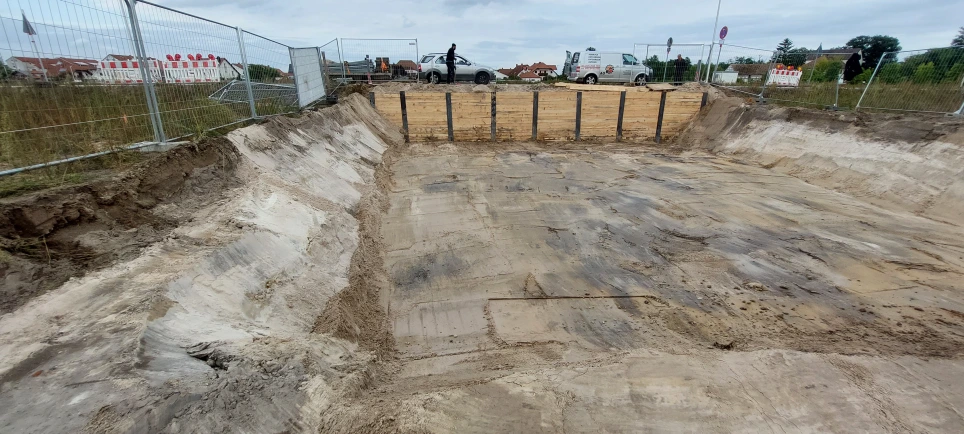
Price dewatering, excavation support and site logistics separately
Additional costs frequently arise from site logistics, water and excavation support. Restricted setup areas, inadequate truck access, water ingress or shoring alter the choice of plant, the construction sequence and the excavation volume.
The quote must state whether mobilization and demobilization of plant, access protection and cleaning, traffic management, waiting time, material handling on the plot, and keeping pumps or support systems available are included.
Access and the loading point determine plant and transport.
Width, height, load-bearing capacity, bends, gradients, overhead lines, the road edge, turning space and the setup area must suit the vehicle. If material has to be moved into position by smaller plant or transferred across the plot, additional operations are required.
Pumping is only one part of the service.
The type and anticipated duration of dewatering, sump or drainage arrangement, filtration, discharge route, possible settlement tanks, power supply, monitoring and permitted discharge point must all be clarified. Rainwater and perched water can also cause downtime or remedial work.
Excavation support changes the area, quantity and schedule.
A battered excavation requires more lateral space and generates more excavated material. Shoring reduces the required area but involves the design, delivery, installation, retention and removal of the system. Soil, water, excavation depth, neighbouring buildings, imposed loads and the available space determine which support concept is required.
Backfilling and base courses must be described as placement work.
Earthworks do not end when the excavated material leaves the site. Working spaces must be backfilled; replacement, frost protection or base-course layers may be required beneath floor slabs, driveways, patios and paths. Material, placed thickness, compaction and verification must be defined for each area. Early planning of the outdoor areas allows these requirements to be coordinated.
“Backfilling included” is too vague. The material type and source, quantity and unit, layer thickness—including whether it applies in the loose or compacted state—and the placement method are all required.
Imported material is often charged by the metric ton or loose volume, whereas the finished layer is measured by compacted volume or calculated from its area and compacted thickness. The quote must allocate these reference quantities unambiguously.
Not every excavated material is suitable for every placement area.
Engineering and environmental suitability, together with the moisture condition, must match the intended placement area. Otherwise, removal and replacement-material costs will arise.
Compaction requires defined layers and sufficient working space.
Material is not simply filled to the final level. Lift thicknesses, compaction equipment, moisture condition and sensitive areas around waterproofing, insulation, services or drainage must be considered. Confined areas may require hand-held equipment and more time.
“Compacted” is not measurable without a target and a test.
The design and quote must specify the target value, test method, test layer, test points and frequency. Depending on the specification, density tests referenced to Proctor density or static or dynamic plate load tests may be appropriate.
Limit variations by defining clear reference quantities
Ground investigations sample the subsoil only at specific locations, so deviations remain possible. The quote must therefore distinguish between base-scope and provisional items and state unit rates for defined quantity changes or additional circumstances.
Unit rates are particularly important for excess quantities, additional journeys, different acceptance categories, dewatering, shoring and additional backfill. For transport and acceptance, the assumed distance, receiving facility and period of price validity must be documented.
Where applicable, the records required for valuation include excavation measurements, documented formation levels, weighbridge and delivery tickets, acceptance receipts, allocation of material streams, compaction test results, and photographs and daily reports recording deviations.
Included and excluded work must be identified.
Site setup, excavation, sorting, transport, acceptance, temporary storage, reuse, compaction, testing and documentation must each be clearly identified as included or excluded.
Document deviations before the affected work continues.
If ground conditions differ, material is suspect or quantities increase, the cause, quantity, photographs, revised material route and pricing basis should be agreed and documented before the affected work continues.
The final account needs a consistent quantity basis.
The contract must define the measurement method for every item: geometric measurement, a digital terrain model, weighbridge ticket or load schedule. Changing the reference quantity makes verification more difficult.
These six points must be clarified before placing the order.
Current plan revision with site plan, sections, levels, excavation geometry, working spaces and the intended support method.
Description of the ground, water conditions, identifiable made ground, existing environmental investigations and their relevance to the intended recovery or disposal route.
Quantities and units for each item: cubic meters in situ, loose transport volume, metric tons or loads, together with the method of subsequent measurement.
Separation and handling of every material stream: reuse, temporary storage, recovery or disposal—including the transport route, receiving facility, fees and required evidence.
Site logistics and additional services: access, setup area, plant transport, dewatering, battered slopes or shoring, traffic management, cleaning and waiting time.
Backfill material, layer build-up, layer thickness in the compacted state, placement method, testing, unit rates for deviations and the final documentation to be provided.
When an earthworks quote can be compared reliably
Quotes can only be compared when the plan revision, excavation geometry, ground zones, quantity units, transport and recovery or disposal routes, backfilling and verification are described unambiguously. Deviations then become visible at an early stage and can be priced as clearly defined additional services.

Have the earthworks checked before placing the order
Send us the plans, levels, ground investigation report, access photographs and any available soil analyses. These documents allow the quantity assumptions, transport routes, receiving facilities and possible additional services to be assessed in advance.

